
# Turnkey Industrial Construction: From Planning to Project Completion
Building a factory, warehouse or industrial facility involves much more than constructing a structure. It requires coordination between planning, civil construction, structural steel, roofing, flooring, services and project execution.
**Turnkey industrial construction** provides a complete solution where one contractor manages multiple stages of the project, helping the client achieve better coordination, quality control and smoother project execution.
## What Is Turnkey Industrial Construction?
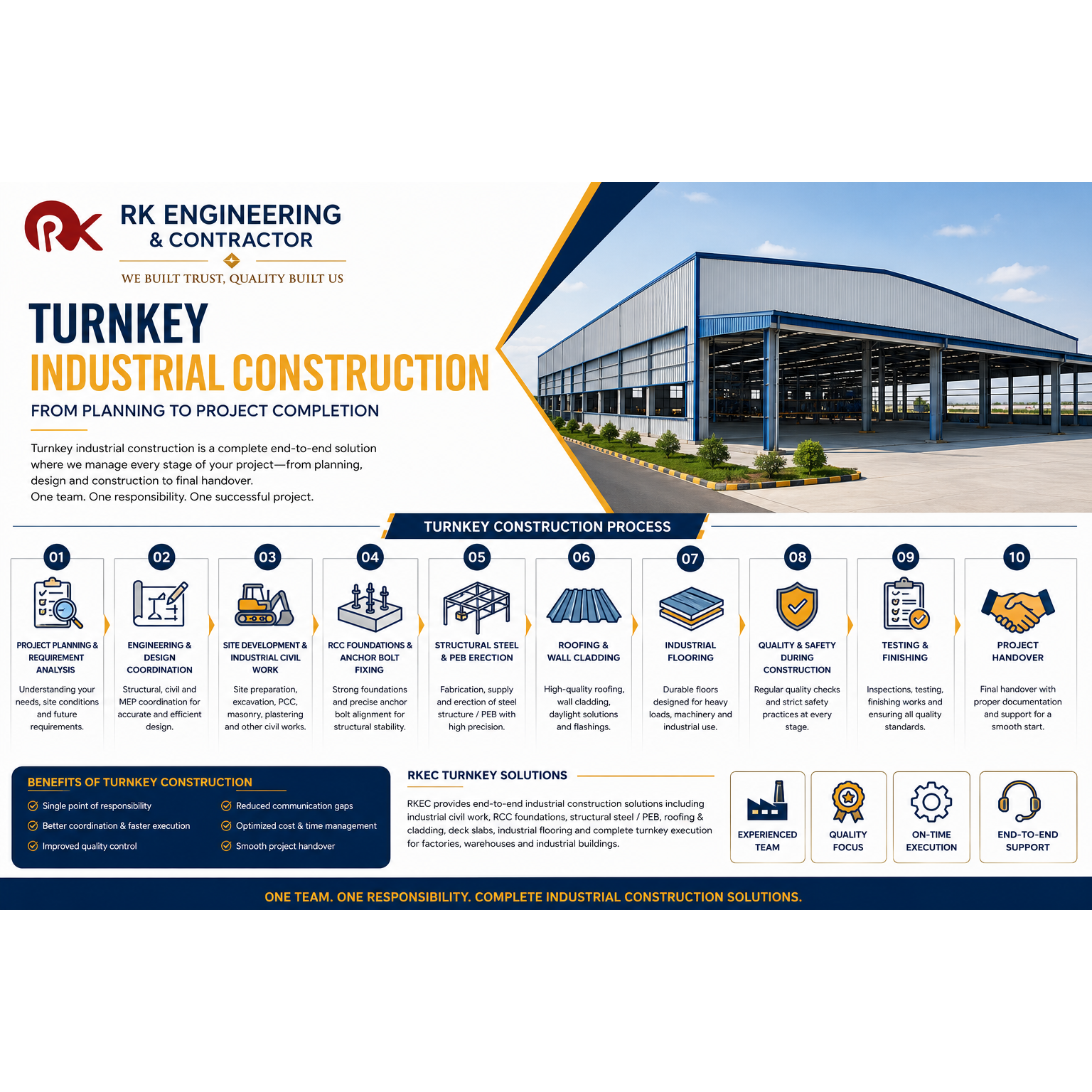
Turnkey industrial construction is an end-to-end approach where a contractor takes responsibility for major stages of a project, from initial planning and engineering coordination to construction, finishing and final handover.
The objective is to provide the client with a completed facility that is ready for use.
## 1. Project Planning & Requirement Analysis
Every successful industrial project starts with proper planning.
The contractor needs to understand the client's requirements, building size, operational activities, storage or production needs, site conditions, access requirements and future expansion plans.
Proper planning helps establish the scope, construction sequence, materials and project requirements before work begins.
## 2. Engineering & Design Coordination
Industrial construction involves multiple engineering disciplines.
Structural design, foundation requirements, PEB or structural steel systems, roofing, drainage and other building requirements need to be coordinated carefully.
Good coordination between engineering and execution teams helps reduce errors, delays and rework during construction.
## 3. Site Development & Industrial Civil Construction
Civil construction forms the foundation of an industrial facility.
Depending on the project, work may include site preparation, excavation, PCC, RCC foundations, pedestals, grade beams, flooring preparation, brick masonry and plastering.
Proper execution at this stage is essential for the stability and long-term performance of the building.
## 4. RCC Foundations & Anchor Bolt Fixing
Industrial buildings, particularly PEB structures, require accurate foundations and anchor bolt positioning.
Anchor bolts connect the structural steel columns to the foundation. Their location, alignment and level must be checked carefully before steel erection begins.
Accurate foundation and anchor bolt work helps ensure smooth structural installation.
## 5. Structural Steel & PEB Erection
Once the foundations are ready, structural steel or PEB components can be erected.
This stage may include columns, rafters, purlins, bracing and other structural members.
Proper fabrication, transportation, lifting, alignment and erection are important for maintaining structural quality and construction efficiency.
## 6. Roofing & Wall Cladding
After structural erection, the building envelope is completed through roofing and wall cladding.
Depending on project requirements, solutions may include standing seam roofing, profile sheets, insulated roofing, wall cladding, polycarbonate daylight sheets and ventilation systems.
Proper installation helps protect the facility from weather conditions and supports the building's long-term performance.
## 7. Industrial Flooring
Industrial floors must be designed according to the intended use of the facility.
Factories and warehouses may require durable concrete or Trimix flooring capable of handling forklifts, equipment, machinery and regular industrial traffic.
Proper floor preparation, reinforcement, concrete placement and finishing are important for achieving a reliable industrial floor.
## 8. Quality & Safety During Construction
Quality control and safety should be maintained throughout the project.
Material inspection, dimensional checks, concrete quality, structural alignment, roofing installation and workmanship should be monitored at different stages.
Safe work practices, appropriate PPE, lifting procedures, housekeeping and working-at-height controls are also essential on industrial construction sites.
## 9. Finishing, Testing & Project Handover
The final stage includes completing remaining works, inspections, corrections and necessary documentation.
Once the construction activities are completed and the facility meets the required project specifications, the building can be handed over to the client for use.
## Benefits of Choosing a Turnkey Contractor
A turnkey approach can provide several advantages:
* Single point of responsibility
* Better coordination between different construction activities
* Improved project planning and scheduling
* Reduced communication gaps
* Better control over quality and execution
* Coordinated civil, structural and roofing works
* Smoother project handover
## RKEC Turnkey Industrial Construction Solutions
**RK Engineering & Contractor (RKEC)** provides turnkey industrial construction solutions cove