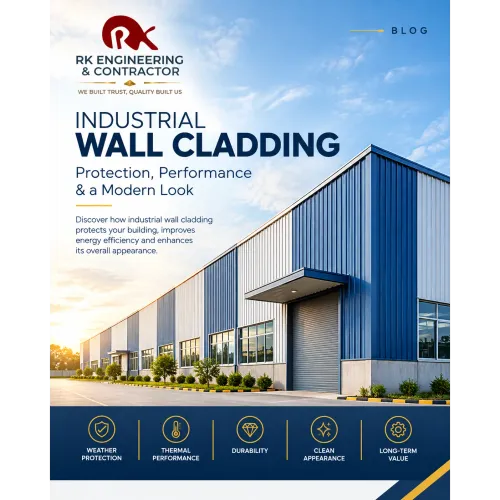


Industrial wall cladding is an important part of modern factory, warehouse and commercial building construction. It protects the building from weather conditions, improves the appearance of the structure and can contribute to better thermal performance when the right system is selected.
The choice of wall cladding depends on the building design, location, insulation requirements, operating environment and long-term maintenance needs.
What Is Industrial Wall Cladding?
Industrial wall cladding is a protective external covering installed over the structural framework of a building. It can be made from profiled metal sheets, insulated panels, standing seam systems and other specially designed materials.
A properly designed cladding system provides a durable building envelope while allowing architects and engineers flexibility in appearance and performance.
Types of Industrial Wall Cladding
1. Profiled Metal Wall Sheets
Profiled sheets are widely used for factories, warehouses and industrial buildings. They are available in different profiles, thicknesses, coatings and colours and provide a practical and economical wall solution.
2. Insulated Wall Panels
Insulated panels combine an external metal skin with an insulation core. They can help improve thermal performance and are suitable for buildings where temperature control and energy efficiency are important.
3. Standing Seam Wall Systems
Standing seam systems use concealed fastening arrangements to provide a clean and modern appearance. They can offer weather-resistant performance when properly designed and installed.
4. Polycarbonate Sheets
Polycarbonate sheets can be incorporated into selected wall areas to allow natural daylight into industrial spaces. They are often used alongside metal cladding rather than as a complete wall system.
Wall Cladding Installation Process
A typical installation involves:
Structural Preparation: The supporting steel structure is checked for alignment, level and readiness.
Purlin & Girt Installation: Secondary structural members are installed to provide support for the cladding.
Cladding Installation: Sheets or panels are positioned and fixed according to the approved design.
Fastening: Suitable fasteners and fixing methods are used to provide secure installation.
Flashing & Sealing: Flashings, trims and sealants are installed around joints, corners, openings and other critical areas.
Final Inspection: The completed cladding is checked for alignment, fixing quality, joints and overall finish.
Benefits of Industrial Wall Cladding
A properly selected and installed wall cladding system can provide:
Protection from rain, wind and weather exposure
Improved building durability
Better thermal performance with suitable insulation
Low-maintenance external surfaces
Faster installation compared with some conventional wall systems
A clean and professional appearance
A wide range of profiles, finishes and colours
Compatibility with modern PEB and structural steel buildings
Applications
Industrial wall cladding is commonly used for:
Manufacturing plants
Factories
Warehouses
Logistics facilities
Commercial buildings
Workshops
Industrial sheds
Cold storage and controlled-environment facilities
How to Choose the Right Wall Cladding
The right system should be selected after considering the building location, weather conditions, internal environment, insulation requirements, material thickness, coating, structural support, appearance and maintenance requirements.
For industrial buildings, coordination between structural steel, roofing, wall cladding, insulation and ventilation is particularly important for achieving an effective building envelope.
RKEC Wall Cladding Solutions
RK Engineering & Contractor (RKEC) provides industrial wall cladding as part of its integrated construction capabilities.
Our services can be coordinated with PEB structures, structural steel, industrial roofing, civil construction, deck slab construction and industrial flooring, providing clients with an integrated approach to industrial building projects.
With a focus on quality, safety and proper execution, RKEC supports industrial and commercial construction requirements across Pune, Mumbai, Goa and surrounding regions.
Conclusion
Industrial wall cladding is more than an external finish. The right system can contribute to weather protection, durability, thermal performance, appearance and long-term building performance.
Choosing the appropriate material and ensuring professional installation are essential for achieving a reliable industrial building envelope.
Planning an industrial building or wall cladding project? Contact RKEC to discuss your requirements.